


RoadActive Suspension VS Airbags
Because of market demand, RoadActive Suspension is most often compared with airbags and traditional helper-spring suspension upgrades. While the RoadActive system certainly reduces rear squat, it delivers much more than load support alone.
A direct comparison with airbags or conventional helper springs is not entirely like-for-like. RoadActive Suspension combines many of the benefits associated with airbags, helper springs, sway bars and traction bars in one integrated system.
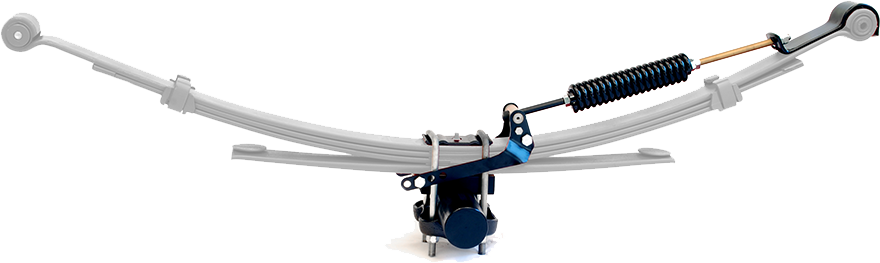
Each kit is tuned to suit the vehicle application. Its variable-rate coil spring applies support progressively as load increases, helping improve stability, reduce bounce and squat, and maintain more consistent handling when towing or carrying weight.
This simple but effective design, combined with high-quality components, makes RoadActive Suspension one of the most versatile rear suspension upgrades available.
Basic Comparison
RoadActive Suspension
RoadActive Suspension kits retail from approximately $1,200–$1,300, depending on the vehicle application. Professional installation is typically around one hour, while most DIY installations can be completed in 60–90 minutes using basic workshop tools and axle stands.
Designed to work with your existing leaf springs, RoadActive Suspension requires no air lines, compressors or ongoing adjustments. Once installed, the system automatically provides progressive support as load increases while maintaining excellent ride quality when unloaded.
Because of the straightforward installation, many owners choose to fit the kit themselves, reducing overall ownership costs.
Price: $1200 - $1300
Price + Labour: DIY installation or approximately 1 hour professional installation.

Airbag Suspension
Airbag suspension systems are designed primarily to level the vehicle when towing or carrying heavy loads. Depending on the brand, a typical kit costs between $750 and $1,200 before installation.
Installation is generally more involved than RoadActive Suspension, requiring air lines, fittings and inflation valves. Many installations also require drilling and careful routing of components, which is why professional installation is commonly recommended.
Professional installation typically takes 3–4 hours, increasing the overall installed cost compared with the initial purchase price.
Price: $750 - $1200
Price + Labour: $1680
Still Thinking About Airbags? Here's What Else You'll Need to Consider
Unlike RoadActive Suspension, airbag systems require ongoing inspection and maintenance to perform at their best. Manufacturers generally recommend regularly checking and adjusting air pressure to suit your load, inspecting the airbags for wear or damage, keeping them clean and free from dirt and road debris, and periodically checking air lines and fittings for leaks. Mounting brackets and hardware should also be inspected to ensure everything remains secure. If your kit is not fitted with an onboard compressor and controller, you'll also need access to an external air compressor whenever you want to increase or decrease air pressure as your load changes. While airbag suspension can be an effective solution for some applications, it requires more ongoing maintenance and adjustment than a mechanical system such as RoadActive Suspension.
Onboard Controller with Air Compressor and Tank
A basic airbag system requires the driver to manually check and adjust air pressure as the load changes. For greater convenience, many owners add an onboard air compressor, tank and in-cab controller, allowing pressure to be monitored and adjusted from the driver’s seat.
This setup improves ease of use but adds considerably to the overall cost and installation complexity. The system requires additional air lines, electrical wiring, mounting hardware and controls. Professional installation is generally recommended unless you have suitable automotive electrical and mechanical experience.
Price: Approximately $1500
Price + Labour: Approximately $2220
Sway Bar
Reducing rear squat does not necessarily eliminate body roll or side-to-side movement. A rear sway bar is designed to reduce body roll and improve stability when cornering, changing lanes or travelling with a high or shifting load.
Sway bars are generally straightforward to install and can be an effective upgrade, but they primarily address lateral body movement rather than suspension sag, axle wrap or load support. Installation time and cost vary depending on the vehicle and available equipment.
Price: Approximately $400
Price + Labour: Approximately $500
Traction Bar
Axle wrap and wheel hop can occur when high torque causes the rear axle housing to rotate against the leaf springs. This can distort the springs under acceleration, reduce traction and create unwanted movement through the driveline.
Traction bars are designed specifically to control axle rotation and improve traction under power. They can be effective for high-torque applications, but they do not provide the broader load-support and stability benefits of RoadActive Suspension.
Price: Approximately $300
Price + Labour: Approximately $500
Product Comparison

True Cost Comparison
When all of the additional components, professional installation and ongoing costs are taken into account, the difference becomes clear.
- Airbag System + Compressor + Professional Installation: Approximately $3,880
- RoadActive Suspension + Professional Installation: Approximately $1,320
- RoadActive Suspension (DIY Installation): From $1,200
RoadActive Suspension delivers load support, improved stability, reduced axle wrap and reduced body roll in a single maintenance-free system—without compressors, air lines or ongoing air pressure adjustments.
Find my kit


